If you’ve just seen a positive pregnancy test, one of the first questions on your mind is probably “how far along am I?” The answer surprises almost everyone — because of the way pregnancy weeks are counted, the number is usually higher than you’d expect. Here’s how it works, and why knowing your dates matters for the choices in front of you.
Pregnancy is counted from your last period
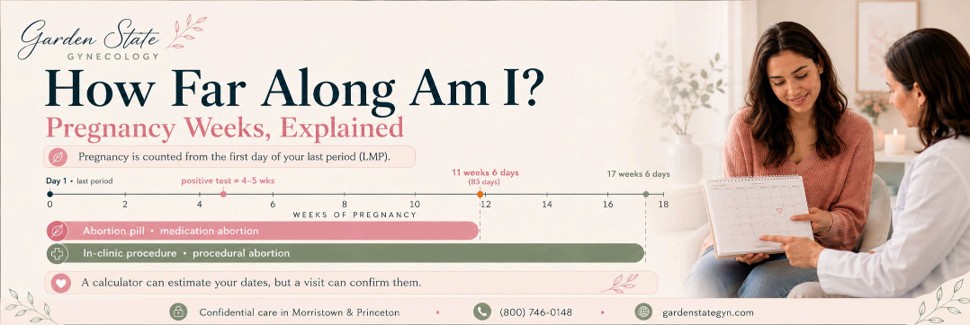
Gestational age — how a pregnancy is measured — is counted from the first day of your last menstrual period (LMP), not from the day you had sex or the day you conceived.
That’s the standard every provider uses, and it has a surprising side effect. Since conception usually happens about two weeks after your period starts, you’re considered roughly two weeks “pregnant” before conception has even happened. So by the time you miss a period and get a positive test, you’re often already around four to five weeks along — not one or two.
You didn’t lose track of time. That’s simply how pregnancy dating works.
Why knowing your pregnancy weeks matters
How far along you are shapes your options and your timeline, so an accurate number helps you make decisions calmly instead of guessing. If you’re considering abortion care, gestational age is the single most important detail:
- The abortion pill (medication abortion) is a non-surgical option available up to 11 weeks and 6 days of pregnancy.
- An in-clinic procedural abortion may be the right option if you’re further along — at Garden State Gynecology, available up to 17 weeks and 6 days.
One quick note on that notation: clinic materials often write these as “11.6 weeks” and “17.6 weeks,” which means 11 weeks and 6 days and 17 weeks and 6 days — not a decimal. It’s an easy thing to misread.
The most reliable way to know is to confirm it
A pregnancy or due-date calculator can give you a rough estimate from your last period, but it’s only an estimate. At your visit, your provider confirms how far along you are using your last-period date and an ultrasound, so you have an accurate picture before deciding anything.
You may have more time than it feels like
A positive test can feel like a countdown. Often you have more time than the panic suggests — but because your options narrow as the weeks go on, it’s still worth confirming your dates early. Whatever you decide, the first step is the same: get an accurate gestational age so you understand your options.
At Garden State Gynecology, that’s exactly what we help with. Abortion is legal in New Jersey, and our Morristown and Princeton clinics provide confidential, compassionate care, with same-day and next-day appointments often available. Free or low-cost options may be available through grant programs, and we welcome patients traveling from states with abortion bans or restrictions — including help with procedure and travel costs. If you’re unsure how far along you are or what comes next, request an appointment or call (800) 746-0148, and we’ll walk you through it.
Frequently asked questions
How is pregnancy measured?
Pregnancy is measured in weeks of gestational age, counted from the first day of your last menstrual period — not from conception. That's why you can be "four weeks pregnant" only about two weeks after conceiving.
How many weeks can you take the abortion pill?
The abortion pill (medication abortion) is available up to 11 weeks and 6 days of pregnancy (written as 11.6 weeks, or 83 days).
How far along can you be for a procedural abortion?
At Garden State Gynecology, procedural (in-clinic) abortion is available up to 17 weeks and 6 days of pregnancy (17.6 weeks).