If you have ever gripped the exam table through an IUD insertion, canceled a Pap smear three times because you couldn’t face it, or been told to “just take some ibuprofen” before an endometrial biopsy, this post is for you.
For years, patients were expected to simply tolerate the pain and anxiety of office gynecologic procedures. That is finally changing. In May 2025, the American College of Obstetricians and Gynecologists (ACOG) released new guidance urging clinicians to stop underestimating procedure pain, to discuss pain management with every patient, and to support access to deeper sedation — including IV sedation and general anesthesia — when it’s warranted and available.
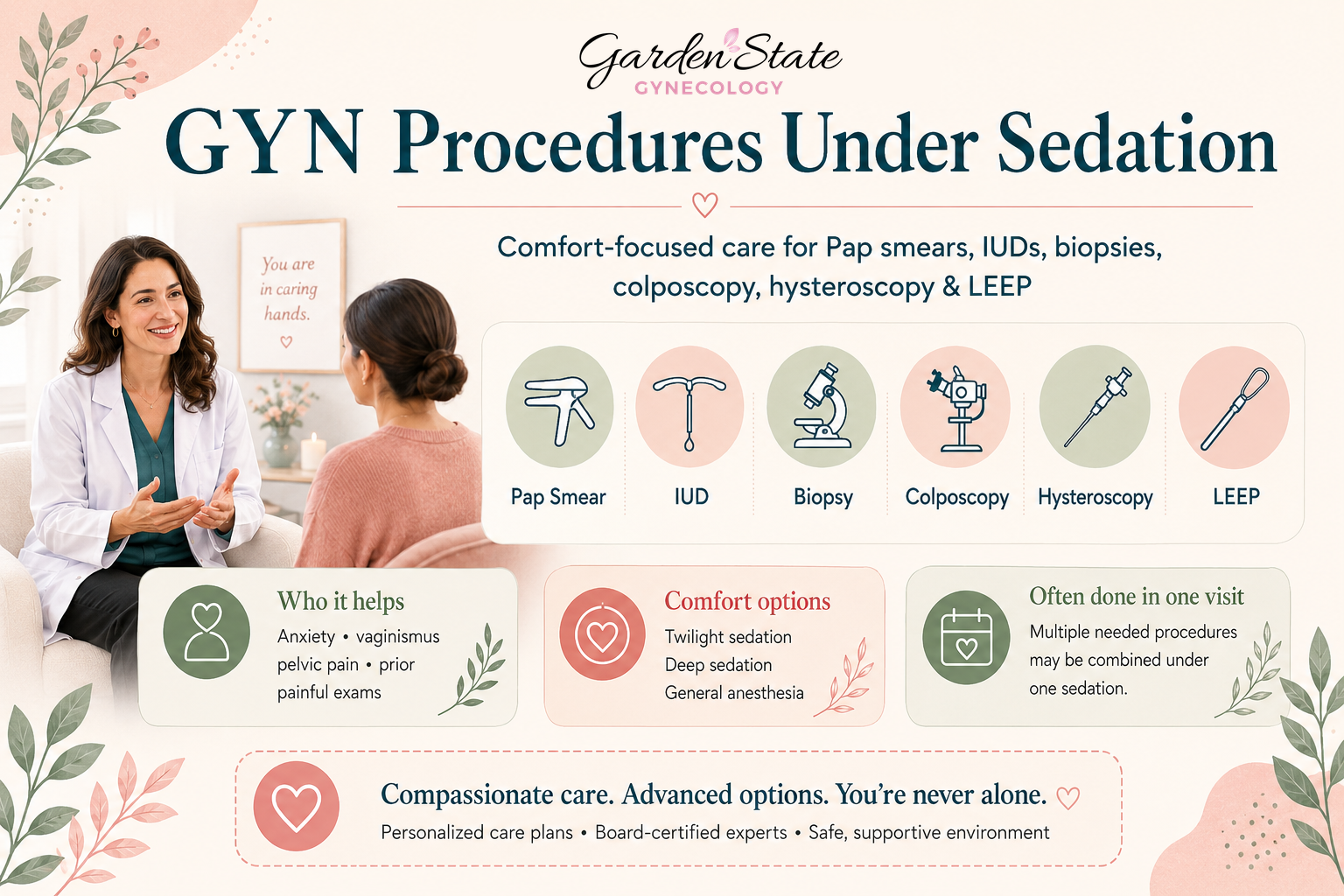
Here is the problem: at most GYN offices, deeper sedation simply isn’t available. At Garden State Gynecology, it is. Our offices are Quad A–accredited for general anesthesia, deep sedation, and twilight sedation, with board-certified anesthesiologists on our team. That means procedures most offices perform while you’re awake can, when appropriate, be completed here under sedation or general anesthesia. If you have been searching for gynecologic procedures with anesthesia in New Jersey, this is it: we are one of a very limited number of practices equipped to offer it.
Why We Offer Sedation for “Routine” Procedures
“Routine” describes how often a procedure is performed. It says nothing about how it feels.
A Pap smear takes a few minutes and causes only mild discomfort for many patients. But for a patient with vaginismus, pelvic pain, or a history of trauma, that same exam can be excruciating — or physically impossible. An endometrial biopsy is often performed in under five minutes with no anesthesia at all, yet many patients describe the cramping as some of the worst pain of their lives.
Research also shows that oral anti-anxiety medication alone doesn’t actually reduce procedure pain — it may take the edge off your nerves, but it does not control the pain of the procedure itself. That is why a “take a Xanax and push through it” approach fails so many patients, and why real sedation options matter.
At Garden State Gynecology, you and your provider decide together how much support you want — from local numbing medication to twilight sedation to full general anesthesia. Your comfort is a medical decision you get to make, not a luxury you have to justify.
Who Benefits Most from Sedation GYN Care
Sedation is an option for many patients — your provider will confirm it is a safe fit for you at your consultation. And for some patients, it’s the difference between getting care and going without it for years:
- Patients with vaginismus (also called genito-pelvic pain/penetration disorder) — an involuntary tightening of the pelvic floor muscles that can make any vaginal penetration, including a speculum exam, painful or impossible. It is more common than most people realize, and it is not “in your head.”
- Patients with anxiety or panic disorders for whom the exam room itself triggers overwhelming distress.
- Survivors of sexual trauma or medical trauma, for whom pelvic exams can be re-traumatizing.
- Patients with cervical stenosis — a narrowed cervical canal, often after menopause or prior cervical procedures — which can make IUD placement and biopsies difficult and very painful.
- Patients who have had a painful or failed attempt before, such as an IUD insertion that had to be stopped.
- Patients with physical disabilities, chronic pelvic pain, or severe vasovagal (fainting) responses to pelvic procedures.
- Anyone who has been avoiding care. If you are years overdue for a Pap or have been putting off an evaluation because of fear or pain, you are exactly who this service exists for. No lectures, no judgment — just a way back to care.
One honest note: for patients with vaginismus, sedation is a bridge to the care you need now — not a treatment for vaginismus itself. Long-term improvement usually comes from pelvic floor physical therapy, dilator work, and counseling, and our providers can connect you with those resources. But you should not have to wait until therapy is complete to get a decade-overdue Pap smear or a biopsy your provider recommended.
One practical note before the list: many of these procedures can be combined under a single sedation, so years of postponed care can often be caught up in one appointment.
GYN Procedures We Can Perform Under Sedation
Pelvic Exam and Pap Smear (Exam Under Anesthesia)
Yes — you can be asleep for a Pap smear. Clinicians call this an exam under anesthesia (EUA). While you are sedated, your provider can complete the pelvic exam, collect your Pap and HPV screening, and perform STI testing if needed — everything a well-woman visit requires — completed while you are sedated rather than endured while awake. For patients who have never been able to complete a pelvic exam, an EUA is often the first step back into routine care.
IUD Insertion
IUD pain has finally become a national conversation, and for good reason. While some patients tolerate insertion well, others experience severe pain — and clinicians have historically underestimated it. We offer IUD placement with sedation, so you can be asleep for the placement and wake up with your birth control already in place.
IUD Removal and Exchange
Most removals are quick, but not all. If your strings are not visible, the device is embedded, or a previous removal attempt failed, retrieval can require instruments and ultrasound guidance that are genuinely painful while awake. Under sedation, we can remove a difficult IUD — and place a new one in the same visit if you want to continue with an IUD.
Endometrial Biopsy
An endometrial biopsy samples the lining of the uterus to evaluate abnormal bleeding or screen for precancerous changes. It is one of the most common office procedures done with little or no pain control — and one of the most painful. Because this biopsy is often medically necessary, patients don’t get the choice to skip it. With us, you get a different choice: to be asleep for it.
Diagnostic Hysteroscopy
A hysteroscopy uses a slim camera passed through the cervix to examine the inside of the uterus — commonly to investigate abnormal bleeding, polyps, or fibroids. It is one of the office procedures national guidance specifically names as painful for many patients, and it pairs naturally with sedation: you rest while your provider gets a complete, unhurried look.
Colposcopy and Cervical Biopsy
A colposcopy is a magnified look at the cervix after an abnormal Pap result, usually with one or more small biopsies. The biopsies cause sharp pinching and cramping, and the anxiety of a possible precancer diagnosis makes the experience harder still. Distraction techniques like music or coughing help some patients cope, but they are not consistently effective for biopsy pain — and they should not be the only option you are offered. Sedation lets us complete a thorough evaluation while you rest.
LEEP (Loop Electrosurgical Excision Procedure)
A LEEP removes abnormal, precancerous tissue from the cervix using a thin electrified wire loop. The standard approach is numbing injections into the cervix while you are awake — which many patients find distressing or intolerable. We can perform your LEEP under twilight sedation or general anesthesia, so treating your abnormal cells doesn’t have to be its own ordeal.
Cervical Polyp Removal
Cervical polyps are common benign growths that can cause spotting and irregular bleeding. Removal is usually quick, but for patients who cannot tolerate speculum exams, it can be combined with sedation — often alongside other needed procedures in the same session.
Vulvar or Vaginal Biopsy
When a skin change on the vulva or in the vagina needs evaluation, a small biopsy is taken. Local numbing works well for many patients, but sedation is available for those who need or prefer it.
Transvaginal Ultrasound
For patients with vaginismus or severe pelvic pain, even the ultrasound probe can be impossible to tolerate. When imaging is needed, it can be performed while you are sedated — frequently combined with an exam, Pap, or biopsy in one appointment.
One Sedation, Multiple Procedures
This may be the most practical benefit of all. If you are overdue for a Pap, need an IUD exchanged, and your provider has recommended an endometrial biopsy, we can often complete all of it under a single sedation — one appointment, one recovery, everything done.
Your Sedation Options
Every plan is individualized during your consultation, but your anesthesia options generally include:
- Local anesthesia — numbing medication at the procedure site while you remain fully awake.
- Twilight (conscious) sedation — IV medication places you in a deeply relaxed, drowsy state. You breathe on your own, and most patients remember little or nothing of the procedure.
- Deep sedation (“asleep”) — medication places you in a sleep-like state while a board-certified anesthesiologist continuously monitors you.
- General anesthesia — you are fully asleep and unaware for the entire procedure.
Our team will review your health history, your procedure, and your preferences to recommend the right level of sedation for you.
Is Sedation Safe for Office GYN Procedures?
Safety is the reason sedation is rare in GYN offices — and the reason we can offer it. Administering deep sedation and general anesthesia safely requires accredited facilities, emergency equipment, and dedicated anesthesia professionals whose only job is monitoring you. Garden State Gynecology is Quad A–accredited for general anesthesia, deep sedation, and twilight sedation, which means our facilities meet or exceed the same national safety standards required of surgical centers. When you choose sedation, two physicians are devoted solely to you: your gynecologist and a board-certified anesthesiologist.
If you choose sedation, you will receive simple instructions beforehand — no food or drink for at least 8 hours before your appointment, and a support person to escort you home afterward. Most patients rest in our recovery area for a short time after the procedure and feel back to themselves within hours; your provider will review when you can resume normal activities based on the procedure performed.
What About Cost and Insurance?
Coverage for sedation depends on your insurance plan and the reason for your procedure; some plans require documentation of medical necessity. Rather than guessing, call us — our billing team will verify your benefits and walk you through your payment options and any available financial assistance before your visit, so there are no surprises.
Compassionate, Judgment-Free Care in New Jersey
Our team includes Board-certified and Board-eligible OB/GYNs, anesthesia providers, and all-female support staff, with female physicians available. We provide LGBTQ+ friendly, trauma-informed care, and appointments are available Monday through Saturday, 7 AM to 10 PM — including same-day and next-day scheduling.
GYN procedures under sedation are available at our Morristown and Princeton, NJ offices. For availability at our Staten Island, NY location, please call our team.
You have waited long enough — and you never have to white-knuckle another exam. Call (800) 746-0148 or request an appointment online to ask about sedation for your Pap smear, IUD procedure, biopsy, hysteroscopy, colposcopy, LEEP, or exam under anesthesia. Every conversation is confidential.
Frequently Asked Questions
Can I be sedated for a Pap smear?
Yes. At Garden State Gynecology, a Pap smear can be performed as an exam under anesthesia (EUA) with twilight sedation or general anesthesia. While you are asleep, your provider can complete your pelvic exam, Pap and HPV screening, and STI testing. This option is especially helpful for patients with vaginismus, anxiety, or a history of trauma
Can I be put to sleep for an IUD insertion or removal?
Yes. We offer IUD insertion, removal, and exchange under twilight sedation or general anesthesia. Sedation is especially valuable for difficult removals — such as missing strings or an embedded device — and for patients who had a painful or failed insertion attempt in the past.
Is an endometrial biopsy painful?
Without anesthesia, an endometrial biopsy causes strong cramping that many patients describe as severe, and it is often performed with little or no pain control. National guidance now urges providers to take this pain seriously. At Garden State Gynecology, you can choose to have your endometrial biopsy under sedation instead of going through it awake.
What is an exam under anesthesia (EUA)?
An exam under anesthesia is a pelvic examination performed while you are sedated in an accredited facility. It allows your provider to complete exams, screenings, and minor procedures that would otherwise be too painful or impossible — commonly for patients with vaginismus, pelvic pain, cervical stenosis, or severe anxiety.
I have vaginismus and can’t tolerate any exam. Can you help?
Yes, and you are not alone — vaginismus is more common than most people realize. We can complete your exam, Pap, or other needed procedures under sedation so your care doesn’t have to wait. Because sedation manages the exam rather than treating vaginismus itself, our providers can also connect you with pelvic floor physical therapy and other long-term treatment resources.
Is sedation safe for office GYN procedures?
Yes, when it is provided in the right setting. Garden State Gynecology is Quad A–accredited for general anesthesia, deep sedation, and twilight sedation, and a board-certified anesthesiologist monitors you throughout your procedure. You will need to avoid food and drink for at least 8 hours beforehand and bring a support person to escort you home afterward.
Does insurance cover sedation for GYN procedures?
Coverage varies by plan and by the reason for your procedure, and some insurers require documentation of medical necessity. Our billing team will verify your benefits before your visit and review payment options and financial assistance with you, so you know what to expect in advance.
Can multiple procedures be done under one sedation?
Often, yes. Many patients combine procedures — for example, a Pap smear, IUD exchange, and endometrial biopsy — in a single sedation session. One appointment and one recovery instead of several separate visits. Your provider will confirm what can be safely combined in your case.