
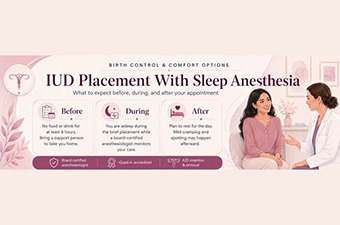
An IUD is one of the most effective, reversible forms of birth control. But pain concerns and anxiety keep some patients from considering one — and if you’ve seen painful insertion stories on social media, you’re not alone in worrying about it.
The short answer: yes, you can be sedated for an IUD insertion. Garden State Gynecology offers IUD insertion and removal with or without sleep anesthesia, administered by a board-certified anesthesiologist. With sleep anesthesia, you’re asleep and closely monitored during the brief placement, and your anesthesiologist tailors the plan to your health and individual needs.
Does IUD Insertion Hurt?
The honest answer: it varies. Some patients feel brief pressure and cramping that fades quickly. Others find insertion genuinely painful — and the stories you may have seen online reflect real experiences, even if they don’t represent everyone’s.
Pain during insertion can be influenced by:
- Your individual anatomy
- Past painful pelvic procedures or exams
- A history of pelvic pain or painful periods
- Anxiety about the procedure
- A prior difficult IUD insertion
Whatever your concern, it’s valid — and worth discussing with your OB/GYN, because you have options.
Can You Be Asleep for IUD Insertion?
Yes. At Garden State Gynecology, sleep anesthesia is available for eligible patients who prefer not to be awake during placement. You fall asleep once the medication is given, sleep through the insertion, and wake up afterward in the recovery area.
Sleep anesthesia may be an especially good fit if you:
- Feel very anxious about insertion
- Had a painful or unsuccessful insertion before
- Have difficulty tolerating pelvic exams
- Have a history of pelvic pain, including endometriosis or vaginismus
- Have been putting off an IUD because of pain concerns
Garden State Gynecology is accredited by Quad A for general anesthesia, deep sedation (“asleep”), and conscious sedation (“twilight”). When you choose anesthesia, two physicians — your OB/GYN and a board-certified anesthesiologist — are devoted to your care and will confirm the plan that’s right for you.
What Happens Before Your Appointment?
Your care team will review your medical history and medications, your birth control goals, the type of IUD being placed (hormonal or copper), and your anesthesia options.
If you’re receiving anesthesia, do not eat or drink anything for at least 8 hours before your appointment time, and bring a support person to take you home after discharge. Always follow the specific instructions the practice gives you.
What Happens During IUD Insertion?
An IUD is a small, T-shaped device placed inside the uterus by an OB/GYN. During the procedure, the physician:
- Places a speculum
- Cleans the cervix
- Checks the position of the uterus
- Guides the IUD into place
- Trims the strings
Placement usually takes only a few minutes. With sleep anesthesia, you’re asleep before the procedure begins, and your anesthesiologist monitors you from start to finish.
What Happens Afterward?
You’ll rest in a recovery area while the anesthesia wears off; expect to feel a little groggy at first. Plan to take it easy for the rest of the day, and do not drive after receiving anesthesia — your support person will take you home, and your discharge instructions will explain when it’s safe to drive again.
Cramping often improves over the next few days. Spotting or irregular bleeding may last longer and can vary depending on the type of IUD.
Seek medical attention for severe or worsening pain, very heavy bleeding, fever, chills, fainting, or foul-smelling discharge.
Does Everyone Need Anesthesia?
No. Many patients choose to have an IUD inserted while awake, and for some, the discomfort is brief and manageable.
Others prefer to sleep through it because of pain, anxiety, past experiences, or simple personal preference. There’s no single right choice — choosing anesthesia isn’t overreacting, and going without it isn’t toughing it out.
IUD Insertion With Anesthesia in New Jersey
Garden State Gynecology offers confidential birth control counseling and IUD insertion or removal — with or without anesthesia — at our Quad A–accredited offices. Our team can walk you through hormonal and copper IUD options, what insertion involves, and the comfort options available to you.
Fear of pain shouldn’t be the reason you rule out an IUD.
Call Garden State Gynecology at (800) 746-0148 or request an appointment at our Morristown or Princeton, New Jersey, locations.
Frequently Asked Questions
Can I request anesthesia for my IUD insertion?
Yes. Garden State Gynecology offers IUD insertion with or without sleep anesthesia. Let the team know when you schedule, and your OB/GYN and anesthesiologist will confirm that anesthesia is appropriate for you.
What kind of anesthesia is used for IUD insertion?
Garden State Gynecology is Quad A–accredited for general anesthesia, deep sedation (“asleep”), and conscious sedation (“twilight”). If you choose sleep anesthesia, a board-certified anesthesiologist will determine the appropriate plan based on your health and individual needs.
Will I feel the IUD being inserted?
With sleep anesthesia, you’re asleep during placement. Without anesthesia, discomfort can range from brief pressure and cramping to more significant pain, and the intensity varies from person to person.
Can I drive home after IUD insertion with anesthesia?
No. You must bring a support person to take you home after discharge, and you should not drive until your discharge instructions say it’s safe.
Can an IUD be removed with anesthesia too?
Yes. IUD removal is also available with or without anesthesia. Routine removal is usually quick, but experiences vary — and anesthesia is an option if you’d prefer to sleep through it.
Can an IUD be removed and replaced the same day?
Yes. If you’re due to have your IUD removed, it can be replaced the same day with a new device, so there’s no lapse in your protection against pregnancy.