
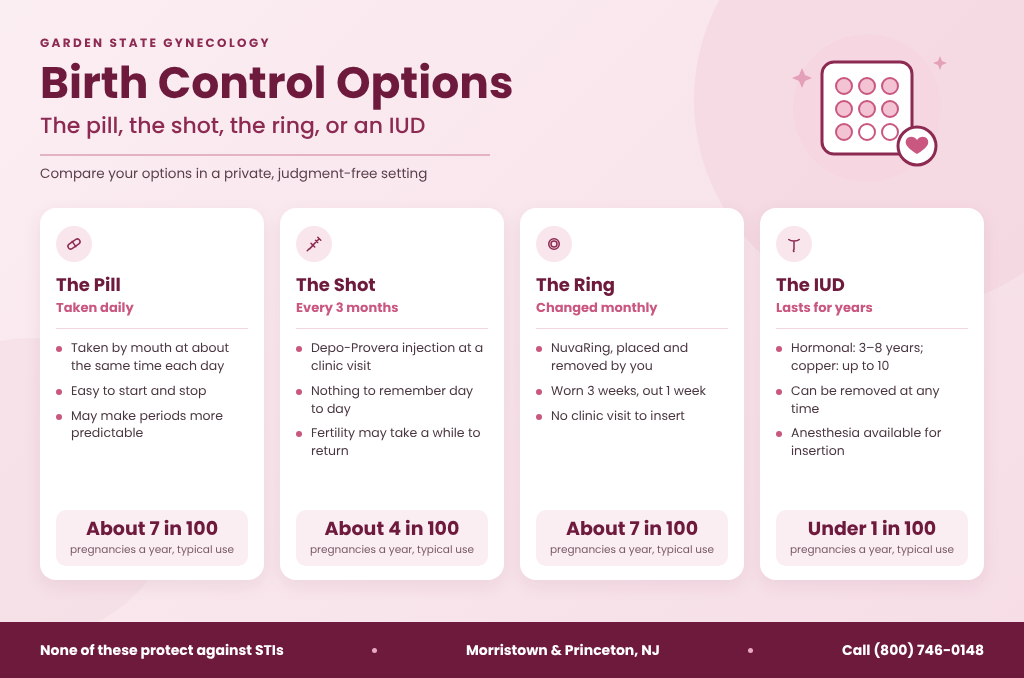
Choosing the right birth control is a personal decision, and with so many options available, it can feel hard to know where to start. The pill, the shot, the ring, and the IUD are four of the most common choices, and each fits a different lifestyle, comfort level, and set of goals.
At Garden State Gynecology, our team helps patients in Morristown and Princeton, NJ compare their options in a private, judgment-free setting. This guide explains how each method works, what to consider, and the questions that can help you decide.
The Birth Control Pill
The pill is taken by mouth at about the same time every day. It is easy to start and stop, it is widely available, and many patients choose it because it fits into an existing daily routine. Some patients also find that it helps make their periods more predictable.
The main consideration is consistency. With typical use, which includes the occasional missed pill, about 7 in 100 people become pregnant in a year. Taking it at the same time each day improves how well it works. Pills that contain estrogen are not right for everyone, so your provider will review your health history before recommending one.
The Birth Control Shot
The shot, known as Depo-Provera, is an injection given about every three months. There is nothing to remember day to day, which makes it a good fit for patients who want an option that is private and low maintenance.
With typical use, about 4 in 100 people become pregnant in a year, a lower rate than the pill or ring. The trade-off is the schedule. You will need to return on time for each injection, and it can take a little while for fertility to return after you stop. If you hope to conceive in the coming months, let your provider know.
The Vaginal Ring
The ring, sold under the name NuvaRing, is a small, flexible ring that you place in the vagina yourself. It releases hormones continuously and is typically worn for three weeks, then removed for a week before a new ring is placed.
Many patients like that there is no daily task, and that the ring can be inserted and removed without a clinic visit. Like the pill, it has a typical-use rate of about 7 in 100, and it requires remembering to change it on schedule. Comfort with placing it yourself is the main factor to consider.
The IUD
An intrauterine device (IUD) is a small, T-shaped device placed in the uterus by a provider. It is the longest-lasting of these four options, and it is more than 99 percent effective, with fewer than 1 in 100 people becoming pregnant in a year. Hormonal IUDs generally last from three to eight years depending on the brand, and the copper IUD can last up to ten years.
An IUD can be removed at any time if you change your mind, and fertility typically returns promptly. Some patients feel nervous about the insertion, and that is common. At Garden State Gynecology, we offer anesthesia for IUD insertion, so you can feel relaxed and comfortable.
How the Four Methods Compare
If you are weighing the options side by side, these are the practical differences:
- Effort: The pill is daily, the ring is monthly, the shot is every three months, and the IUD requires no routine upkeep for years.
- Effectiveness with typical use: The IUD is the highest, followed by the shot, then the pill and ring.
- Provider visits: The pill and ring are prescribed and refilled, the shot requires an injection visit every three months, and the IUD requires an insertion visit and a removal visit.
- Reversibility: All four can be stopped when you are ready, though the shot may take longer for fertility to return.
- STI protection: None of these methods protects against sexually transmitted infections, so condoms are still recommended, if that is a concern.
Questions to Ask Yourself
The right method is the one that fits your life. Consider these questions as you decide:
- How often do I want to think about birth control?
- Am I hoping to become pregnant in the next year, or is that further away?
- Do I have health conditions, or a family history, that my provider should review?
- How do I feel about a procedure, an injection, or placing something myself?
- Have I used a method before, and what did I like or dislike about it?
It is also normal to change methods over time. Many patients try one option and switch as their needs change, and our team is happy to help at every stage. If you are starting a method after a pregnancy loss or abortion, our guide to birth control after abortion explains the options and timing.
Find the Right Birth Control at Garden State Gynecology
You do not have to decide alone. At Garden State Gynecology, we offer confidential, affordable birth control services at our Morristown and Princeton, NJ offices, with caring providers who will listen to your preferences. Call us at (800) 746-0148, or schedule an appointment online. We are open Monday through Saturday, 7 AM to 10 PM.