
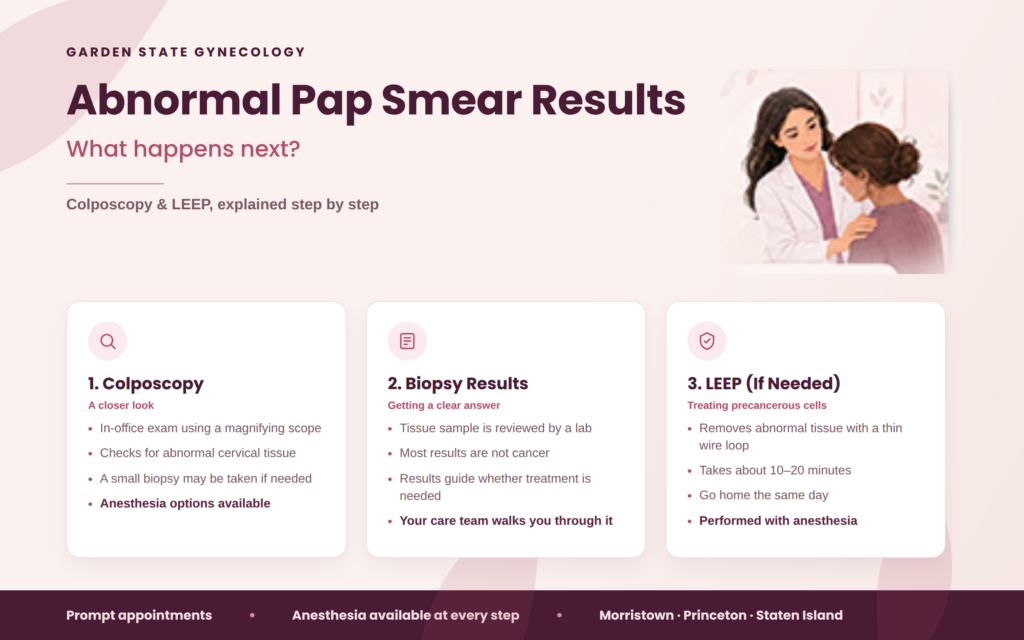
Getting a call that your Pap smear came back abnormal is unsettling, even when you know intellectually that it’s common. If this just happened to you, take a breath: an abnormal result does not mean you have cancer. It’s a signal that something on your cervix needs a closer look, and there’s a clear, well-established path for figuring out what it means and, if needed, treating it.
At Garden State Gynecology, our experts break down what an abnormal Pap result could mean and your next steps.
What an Abnormal Pap Result Actually Means
A Pap smear screens for changes in the cells of your cervix. An abnormal result can point to inflammation, infection, or precancerous changes. Often, it’s connected to HPV (human papillomavirus), a very common virus and a leading cause of cervical cancer. For that reason, patients between 30 and 65 are frequently offered a combined Pap and HPV test, which can extend the interval between screenings to every five years instead of three.
Screening guidelines generally call for testing every three years between ages 21 and 29, and every three years (or every five with HPV co-testing) from 30 to 65. If you’re over 65 with a consistent history of normal results, your provider may tell you screening isn’t needed anymore. If you’re at higher risk, due to HIV, a weakened immune system, or a smoking history, you may need more frequent checks. None of this changes the fact that an abnormal result simply means your provider wants more information before deciding on next steps.
Step One: Colposcopy
If your Pap comes back abnormal, the usual next step is a colposcopy. This is a simple in-office exam that lets your provider examine your cervix closely using a colposcope, a lighted magnifying device. A healthy cervix looks pink and smooth; your provider is checking for white patches, warts, polyps, swelling, or other irregular tissue that wouldn’t show up on a standard exam.
Before the appointment, you’ll typically be asked to avoid intercourse for 24 to 48 hours, skip tampons, and schedule outside your period so that the view isn’t obscured. During the exam, if anything looks abnormal, your provider may take a small tissue sample, or biopsy, to send for testing. Garden State Gynecology offers anesthesia options for the procedure, allowing you to stay comfortable throughout. Findings from the visual exam are typically reviewed with you right away, though biopsy results take longer to come back from the lab.
If a biopsy was taken, expect to avoid intercourse and tampons for about a week, with possible mild discomfort and light bleeding during that time. If no sample was needed, there are usually no restrictions beyond a day or two of light spotting.
Step Two (If Necessary): LEEP
If the colposcopy biopsy shows precancerous cell changes that need to be removed, the next step is often a LEEP, or Loop Electrosurgical Excision Procedure. This is both a treatment and a way to get a larger tissue sample for further diagnosis.
During a LEEP, your provider inserts a speculum and may use the colposcope again for a magnified view. A thin wire loop carrying an electrical current removes the abnormal tissue from the cervix. The entire procedure typically takes 10 to 20 minutes, and it’s performed with anesthesia, so you’re comfortable from start to finish.
Afterward, you can go home the same day and resume your normal activities. It’s common to experience mild cramping, some bleeding, and watery, pink-tinged discharge for a while. Contact the office right away if you notice heavy bleeding, blood clots, fever, or severe pain, since these can signal a complication that needs attention.
The tissue removed during a LEEP is sent to the lab to determine whether the abnormal cells are fully addressed or whether further testing or treatment is needed. LEEP is considered a safe and effective way to remove precancerous cells and reduce the risk of cervical cancer developing.
Why This Process Matters
The colposcopy-then-LEEP pathway exists because cervical cancer is highly preventable when precancerous changes are caught and treated early. Most abnormal Pap results never progress to cancer at all, and the extra steps, colposcopy for a closer look, biopsy for a definitive answer, LEEP if treatment is needed, are designed to catch and resolve the small number of cases where changes could become a problem down the road.
What to Do Next
If you’ve just received an abnormal Pap result, the most useful thing you can do is schedule the follow-up exam your provider recommends rather than sitting with uncertainty. Garden State Gynecology offers colposcopy and LEEP with anesthesia available at every step, so discomfort doesn’t have to be a barrier to getting answers.
Call (800) 746-0148 or request an appointment online at one of the Morristown, Princeton, or Staten Island locations to talk through your results and what comes next.
This article is for general educational purposes and isn’t a substitute for individualized medical advice. Please discuss your specific results and recommended follow-up with your healthcare provider.